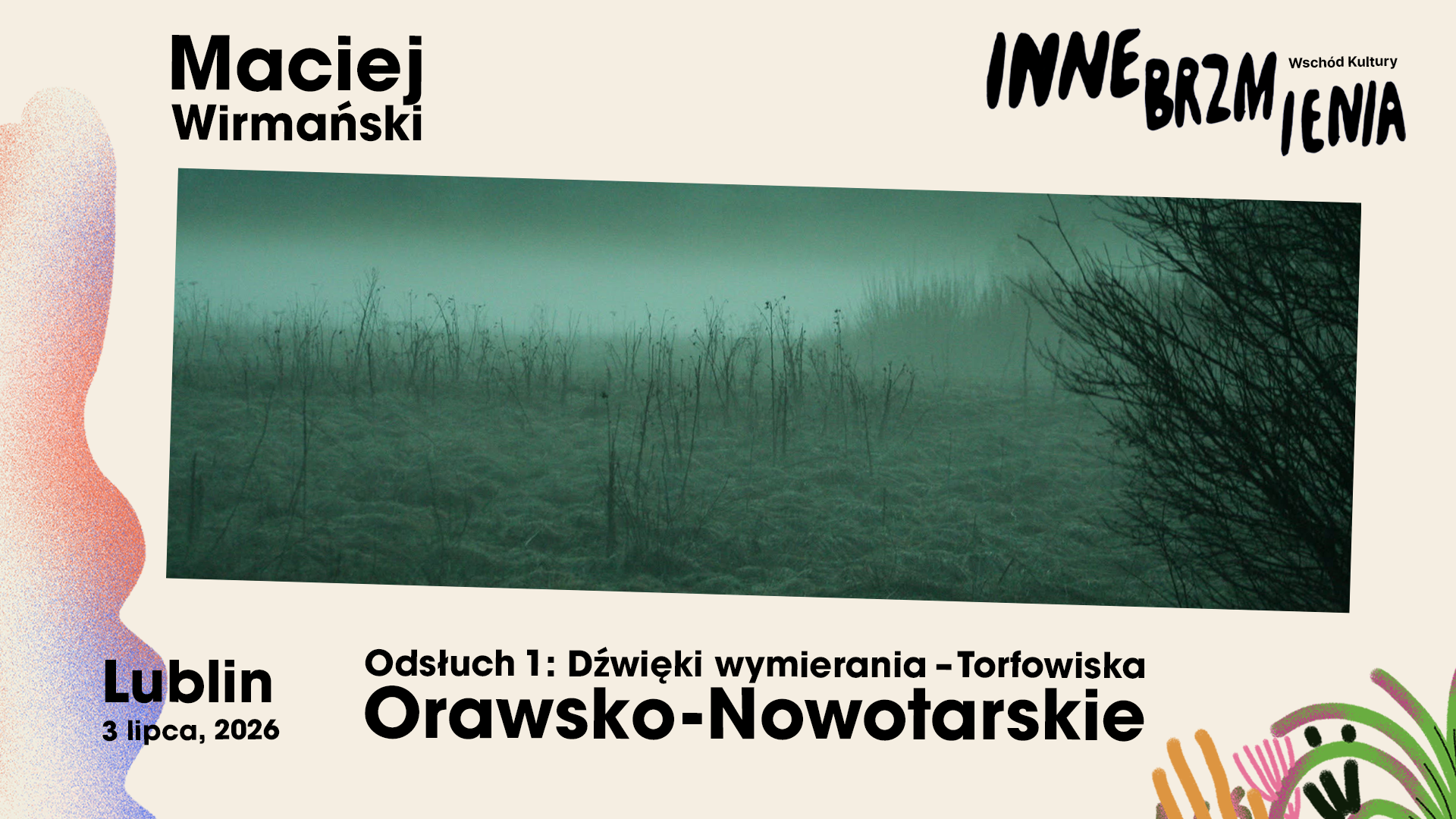

Sound reset | “Sounds of Extinction – The Orava-Nowy Targ Peat Bogs” | Maciej Wirmański
About the listening session
The Orawa-Nowy Targ Peatlands are a Natura 2000 area stretching across southern Małopolska, in the Orawa-Nowy Targ Depression, from Chochołów to Nowy Targ. Southern Małopolska is an area mainly associated with mountain habitats and landscapes; however, between the Gorce Mountains, Babia Góra and the Tatra Mountains lies a little-known flatland dominated by peat bogs, wetlands and swamp forests.
Calls for the protection of these habitats appeared as early as the beginning of the 20th century, and a small fragment of the Orawa-Nowy Targ Peatlands – Bór na Czerwonem in Nowy Targ – was designated a nature reserve as early as 1925. At that time, the remaining Orawa-Nowy Targ Peatlands were subject to human pressure: peat extraction, drainage, cutting of swamp forests, and conversion of wetlands into fields and meadows.
Despite centuries of pressure from forestry, agriculture and mining, the Orawa-Nowy Targ Peatlands remain a rich complex of unique habitats that are home to many organisms. Although there is currently no need for exploitation of this area, it is being systematically destroyed by global climate change, pressure from hunters, foresters, developers and local authorities. The peatlands are damaged by continuous drainage works, the destruction of beaver dams, and illegal off-road vehicle, quad and motorcycle traffic. Drained peatlands are also frequently affected by destructive fires.
“Dźwięki wymierania – Torfowiska Orawsko-Nowotarskie” consists mainly of sounds from a natural environment that has been severely damaged by humans and, despite scientists’ calls for the creation of a national park or landscape park with a network of nature reserves, continues to be destroyed. The recorded sounds are far from dramatic events: they are birdsong, the sound of streams and wind moving through trees, and distant sounds of villages. The song of a skylark appears over a dying peatland where, just 30 years ago, dozens of black grouse gathered for their leks. Duck recordings were made at a fire reservoir located in a former peat excavation pit near the last active and legal peat mine. The sound of a clear stream is in fact water flowing through a drainage ditch that is leading to the peatland’s destruction. A barking fox was recorded near a den that is still being destroyed by hunters. The distant sound of a tractor is not a sign of harvest, but an offence: an unknown perpetrator, as later noted in a police report, is transporting illegally extracted peat on a cart.
The recordings were made between 2019 and 2026 in the Orawa-Nowy Targ Peatlands in the municipalities of Jabłonka, Czarny Dunajec and Nowy Targ.
About the author
Maciej Wirmański – sound engineer, field recordist, musician, publisher, curator of music scenes, cultural activist, music critic. He works with field recordings and soundscapes composed of found sounds for art and museum exhibitions. He creates sound installations, theatre music and film music. Since 2017 he has run the Szara Reneta Tapes label, which releases experimental music, noise, field recordings and radio plays. As part of the Magury ’97 project, he creates fake folk noise music inspired by the Carpathian Arc. He works as a sound engineer for film, TV, documentaries and other audio productions, focusing on post-production of sound and music. He lives and works in Podhale. Amateur birdwatcher.
Details
When: 3 July, Friday, 11:00–12:00
Where: Workshops of Culture in Lublin, Grodzka 5a – auditorium
Admission free
How to prepare for the listening session
Arrive at least a few minutes before 11:00 and choose your listening space; cushions, deck chairs and blankets will be available.
Turn off your phone and do not use it during the session – the room will be darkened and the screen light may disturb others.
If possible, avoid leaving during the listening session – it may distract other participants.
A mind accustomed to listening to music may initially struggle to follow subtle individual sounds – give yourself time: close your eyes, relax, and follow the diversity and changes in the soundscape.
Each listening session consists of several dozen minutes of sound without visual stimuli – consciously give them up and begin to listen more deeply, more widely, more attentively.
Attention! The listening room closes shortly after 11:00, so please be punctual!
Accessibility
Sound resets are accessible for blind and visually impaired people. If you would like to attend and need assistance, please let us know by email no later than 3 days before the festival – send a message to: wolontariat@warsztatykultury.pl.