Sound reset | “Crying Glacier” | Ludwig Berger | listening session and film screening | POL, ENG
About the listening session
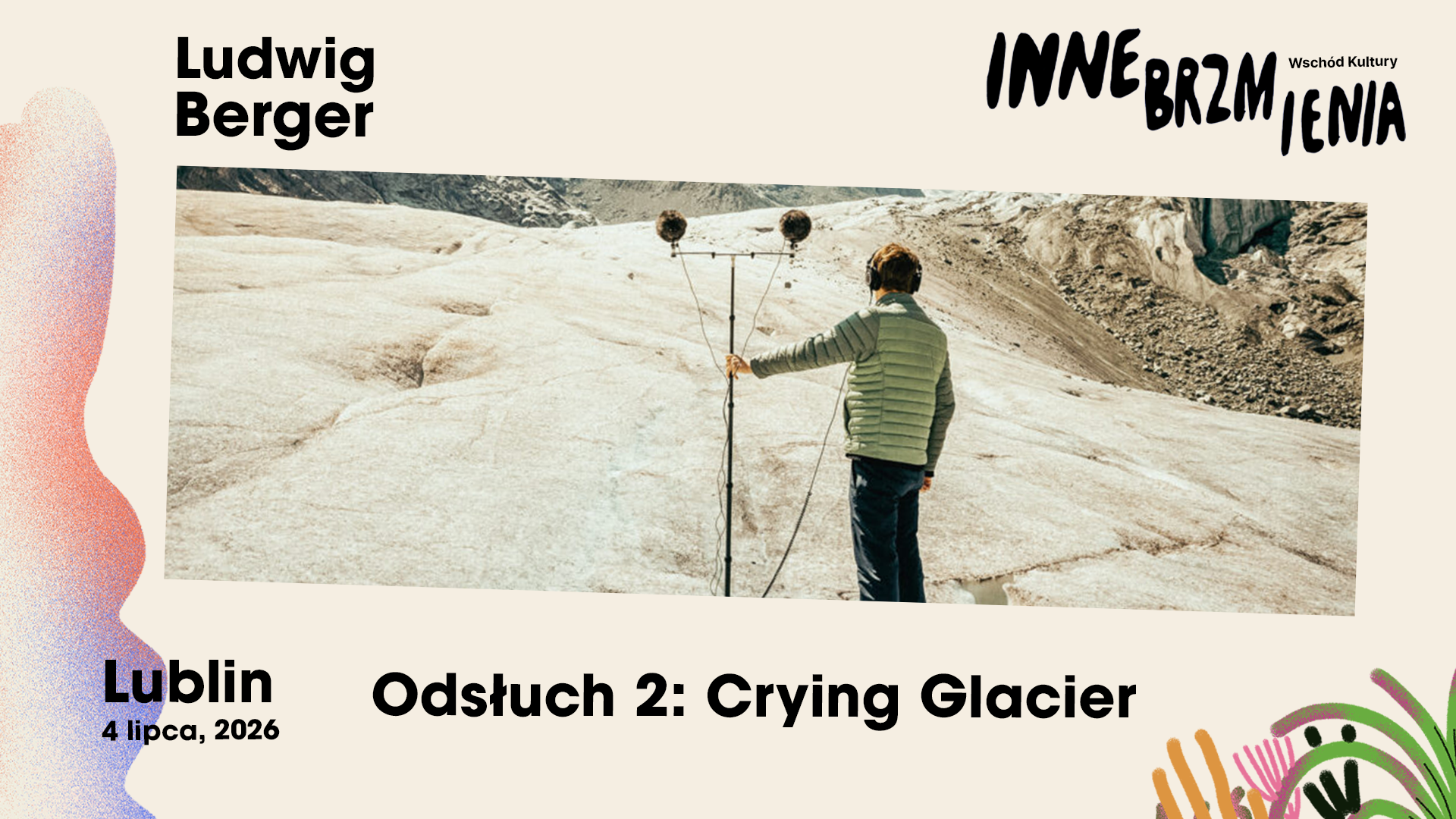
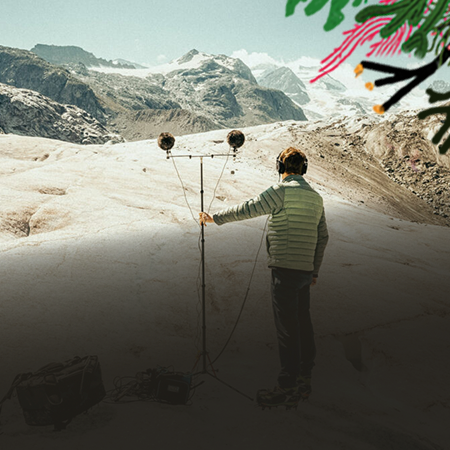
“Crying Glacier” is a project by sound artist Ludwig Berger, comprising a field recordings album, a sound installation, and a short documentary film. Together, they document Berger’s long-term practice of listening to and recording the sounds of the Morteratsch Glacier in the Swiss Alps. For over a decade, Berger has regularly returned to the site, and these visits have gradually begun to resemble encounters not so much with a place, but with a living, changing entity. “Crying Glacier” reveals a unique relationship between the artist and the glacier, inviting us to listen to a landscape that is irreversibly changing before our eyes and ears.
During Different Sounds, we will listen to field recordings from the album “Crying Glacier”, selected by Bandcamp and A Closer Listen as one of the most important field recording releases of 2025. Each track reveals a subtle yet highly complex sonic landscape of the Morteratsch Glacier. In water-filled crevices, peculiar voices emerge – some resemble birdsong, others human speech, and still others evoke the sound of synthesizers. Overlapping, they form a dense, multilayered texture of glacial noise. Melting ice reveals a rich repertoire of acoustic phenomena: murmurs, growls, bubbling, cracking, fractures, and rushing water. The Morteratsch Glacier speaks its own language, and the diversity and expressiveness of its sounds are truly captivating.
Immediately after the listening session, there will be a screening of the short documentary film “Crying Glacier” (14’13”, dir. Lutz Stautner), nominated for the News & Documentary Emmy Awards in the category “Outstanding Climate, Environment or Weather Coverage”. The film explores the process of recording the glacier’s sounds and the ideas behind the project. In its final scene, it delivers a striking warning: “Without effective climate protection, there is a high probability that Ludwig Berger’s recordings will outlive the Alpine glaciers.” “Crying Glacier” is therefore not only a unique listening experience, but also a powerful testimony to environmental change.
“This is more than a scientific record – it is an almost intimate sensory experience that confronts the listener with the tangible reality of global warming” (Radio Télévision Suisse).
About the author
Ludwig Berger – sound artist, composer, educator. In his artistic practice he combines acoustic ecology, deep listening, and poetic narration, creating sound installations, compositions, sound walks, and radio documentaries. His work moves between interspecies, geological, and architectural listening, with a particular interest in microscopic acoustic phenomena such as insect communication, plant rhythms, and the sounds of melting glaciers. He studied electroacoustic composition, musicology, art history, and German literature. As a researcher and lecturer at the Institute of Landscape Architecture at ETH Zurich, he focused on the sonic dimension of Alpine glaciers and water infrastructure. His work has been recognized with awards including the Prix Ars Electronica and the Sound of the Year Awards. His projects have been presented at the United Nations headquarters in New York, the Venice Architecture Biennale, the Canadian Centre for Architecture in Montreal, ZKM Karlsruhe, and at GRM Acousmonium in Paris.
Details
When: 4 July, Saturday, 11:00–12:00
Where: Workshops of Culture in Lublin, Grodzka 5a – auditorium
Admission free
How to prepare for the listening session
Arrive at least a few minutes before 11:00 and choose your listening space; cushions, deck chairs and blankets will be available.
Turn off your phone and do not use it during the session – the room will be darkened and the screen light may disturb others.
If possible, avoid leaving during the listening session – it may distract other participants.
A mind accustomed to listening to music may initially struggle to follow subtle individual sounds – give yourself time: close your eyes, relax, and follow the diversity and changes in the soundscape.
Each listening session consists of several dozen minutes of sound without visual stimuli – consciously give them up and begin to listen more deeply, more widely, more attentively.
Attention! The listening room closes shortly after 11:00, so please be punctual!
Accessibility
Sound resets are accessible for blind and visually impaired people. If you would like to attend and need assistance, please let us know by email no later than 3 days before the festival – send a message to: wolontariat@warsztatykultury.pl.